
Doing It Isn’t Enough — It Has to Be in Place
發布時間:
Jason Hung · 2026-11-10 · English
Published as a professional article on 2026-11-10. Also available in Traditional Chinese.
Quality management at the floor level comes down to one pair of things: people and systems. And the bottom line is a single sentence: never ship a product that has a problem.
A risky exception is not automatically forbidden. But where the risk sits, how large it is, and whether it is risk we can carry — all of that has to be controlled in the open. Only acceptable risk gets released, and whoever signs the release should know exactly what he signed.
All of it rests on one precondition: the product itself has to be made properly. My whole experience in manufacturing quality fits into one line — doing it isn’t enough; it has to be in place. The “place” is the red line: five kilograms of pressure, alignment inside tolerance. Where that line sits has to be unambiguous. Cross it and the work counts. Miss it and it doesn’t, however smooth it felt.
The biggest enemy of “in place” is that people cannot hold a working standard consistently. That is the long-term problem to solve. Until the step is automated, the risk is always there.
Break a manual station into its parts: applying, pressing, alignment, fixture stability. Each one is a possible source of defects, and each one drifts. A fixture adjusted yesterday is half a hair loose today. The operator who pressed perfectly last week is on a different shift this week — different mood, different hand.
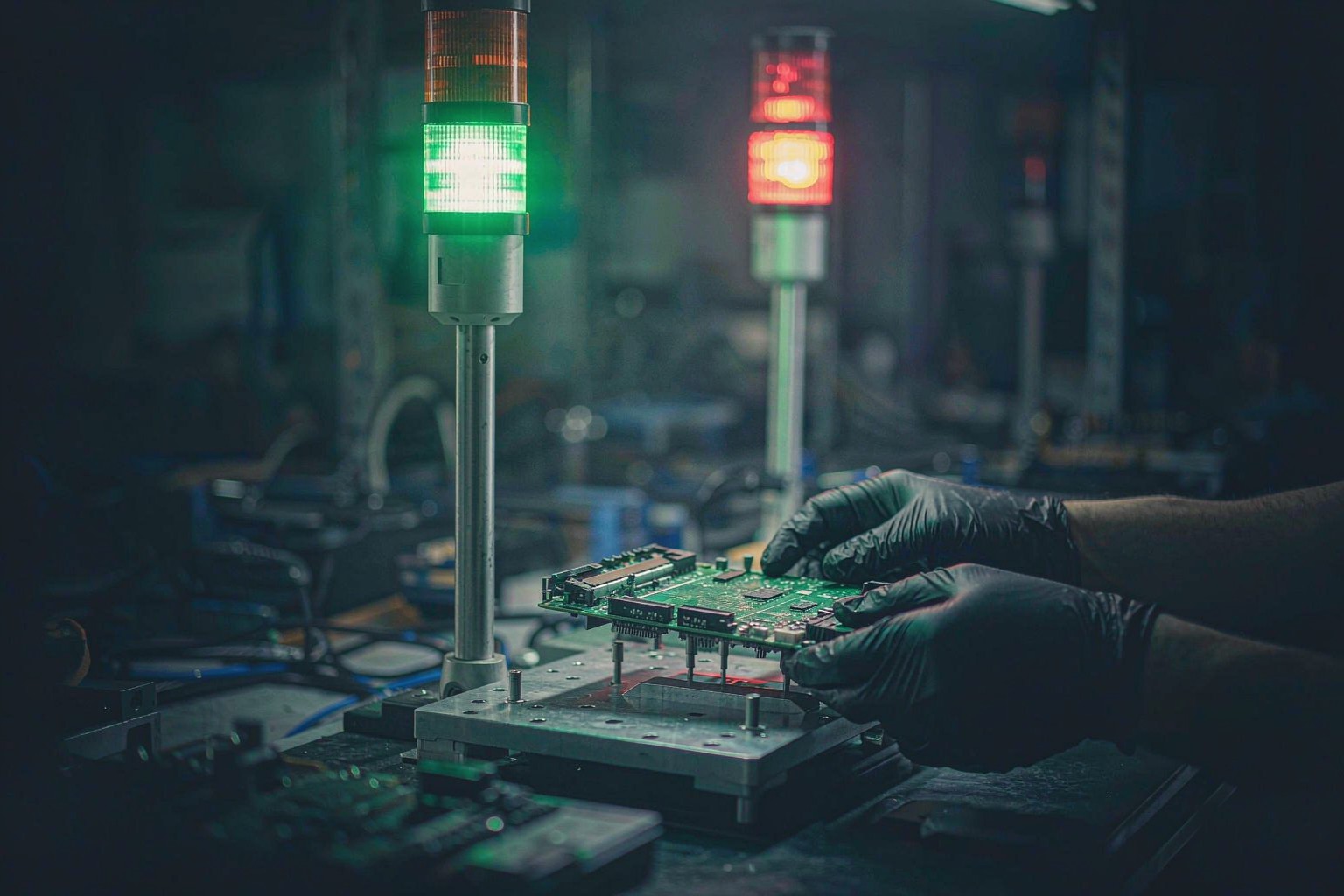
So when I optimize a station, I use a signal-tower system: applying, pressing, alignment and fixture stability all get sensor verification. If the bond needs five kilograms, a pressure sensor goes on — and only then does the press count.
There is a distinction here that has to be made. Green means in place. Red means only that the operator feels he did it well.
How it feels doesn’t count.
The red line is enforced. After it was, defects caused by the operation dropped 99 percent.
Only here does AI actually enter. What it gives you is not a production record but a production biography — precise to how much force each step used and what the assembly resistance was. Nothing is reconstructed afterward; it is recorded and judged at the moment it happens.
Don’t assume automation is immune. Automation is not just pressing. Without full contact-surface data, error grows where nobody is looking, and nobody knows while it grows — by the time anyone does, it is already a defect. AI can help, but only if you give it the complete contact-surface data.
Having a baby is not finished when the baby arrives. Every contraction, every push, leaves something irreversible behind.
A product is the same. Quality is not decided at final inspection — it is set at every application of adhesive, every press, every alignment. Quality management, in the end, is making sure that every one of those irreversible moments is watched — by a person, or by a system.